Gyoka 漁家
Built low, because the wind is the enemy and not the cold.
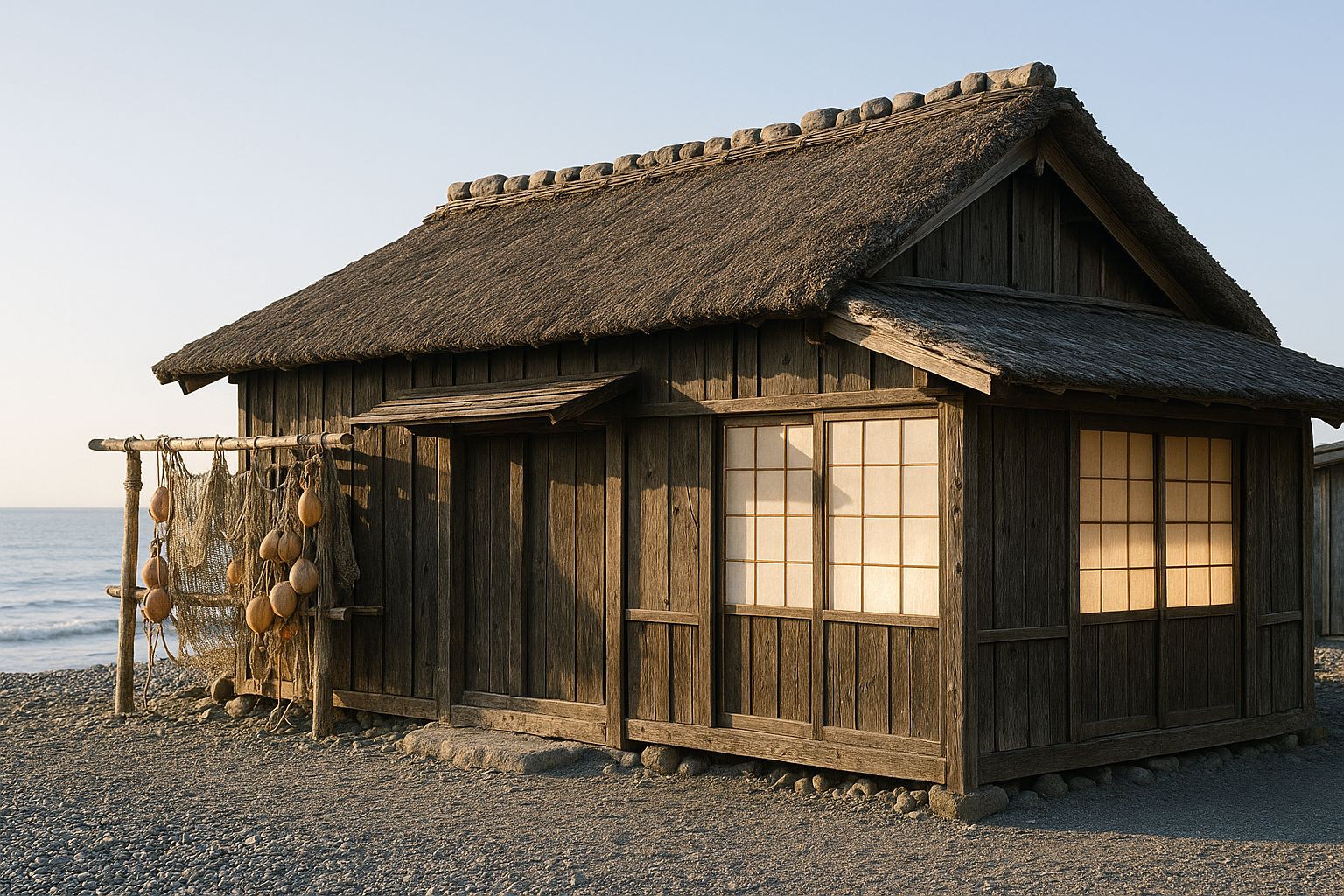
A fishing household's house is a nōka that has been argued with by the sea. Everything that sticks up gets taken by the wind, everything that faces the weather gets eaten by salt, and the answers to both are visible from the road.
- Typical size
- 3 × 5 ken · 15 tsubo
- Kōbai
- 8 sun · 38.7° — deliberately low
- Roof
- Kaya thatch, ridge weighted with stone
- Cladding
- Yakisugi — charred cedar board
- Eave
- Shortened, to deny the wind a lever
- Doma
- Up to 45% of the plan, with a net loft
Section and plan.
Drawn from the same model that runs Sumitsuke, at the size this house is usually built. Open it there and the bays, the site exposure, the earth floor, and the module all become yours to set.
Open this house in Sumitsuke01
The roof is held down, not just held up
A steep roof on an exposed shore is a sail. Coastal houses drop the pitch — 8 sun and under, well below the inland figure — and shorten the eave, because a deep overhang in a gale becomes a lever trying to lift the roof off the wall plate.
Then the ridge is weighted. Rows of rounded beach stones are laid along the mune, and along the exposed slope, to hold the thatch against uplift. It is the plainest engineering on any Japanese building and it is entirely effective.
02
The cladding is burnt on purpose
Yakisugi 焼杉 is cedar board charred on one face until a layer of carbon forms, then cooled and brushed. The char is not decorative. It is a sacrificial surface that salt spray, insects, and fungus do not attack, and it buys a coastal wall fifty or eighty years where bare cedar would give twenty.
It is also why a gyoka reads black at the wall and gold at the roof — a division you will not see inland, and one of the fastest ways to place a Japanese house by looking at it.
03
The doma is bigger, and it is wet
A fishing household brings its work indoors more than a farming one: nets to mend and dry, lines to coil, gear to store out of the salt. The earth floor runs to nearly half the plan, and there is usually a loft over part of it for net storage, reached by a fixed ladder.
The irori sits closer to the doma edge than in a nōka, because the fire is doing double duty — heating the family and drying the gear.
Same valley, different weather.
Raise one, move one, or bring one back.
Tell us the site and the weather. We answer every brief, and we will say plainly if we are not the right workshop for it.