We are asked about forty houses a year.
We take four.
Mitate 見立て is the word a physician uses for a diagnosis and a carpenter uses for reading a building. It is not a valuation and it is not a survey for a bank. It is one question, answered in a day on site: is this frame worth another two hundred years of somebody's life?
Most of the time the answer is no, and the useful thing we can do for an owner is say so quickly and for a fixed fee, rather than slowly and for a percentage. The four tests below are the whole standard. We have not held anything back to keep the decision ours.
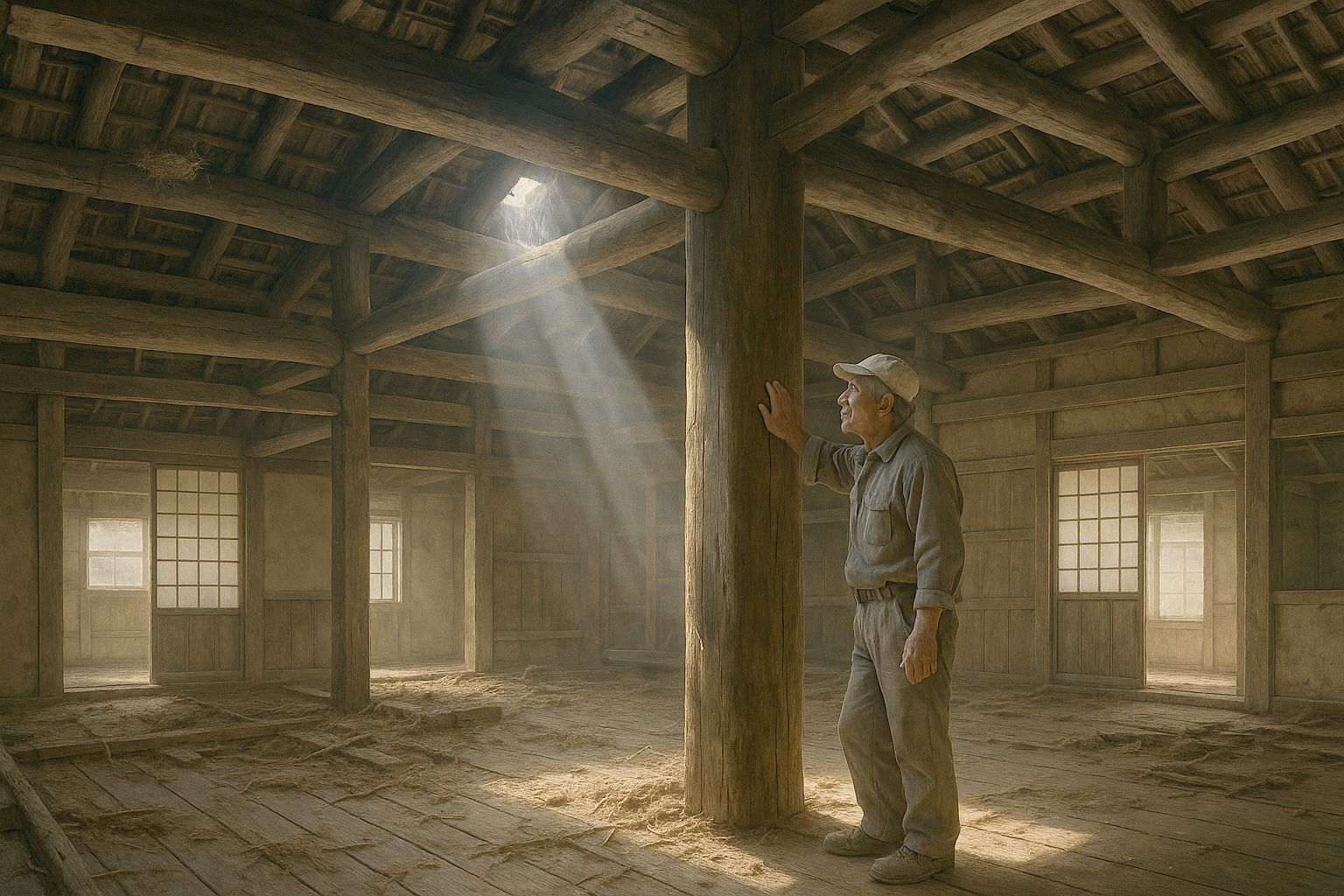
A frame either carries another two hundred years, or it does not.
The frame 軸組
Pre-war, and cut by hand.
We are looking for a frame jointed without nails — mortice, tenon and wedge — in timber taken from one valley. Post-1950 houses are dimensioned lumber on a plan drawn elsewhere, and there is nothing in them a carpenter can save that could not be bought new for less.
Fails on Sawn stock, bolted plates, or a frame under seventy years old.
The great pillar 大黒柱
The daikokubashira sound to the core.
One post carries the argument of the whole house. We sound it, we cut a small plug from its foot where the damp would have got in first, and we look at what comes out. A hollow heart at the base means the house has been drinking for twenty years and the frame around it has been quietly redistributing load ever since.
Fails on Rot at the foot, or a pillar already sistered with steel.
The roof 屋根
Re-thatchable, not merely replaceable.
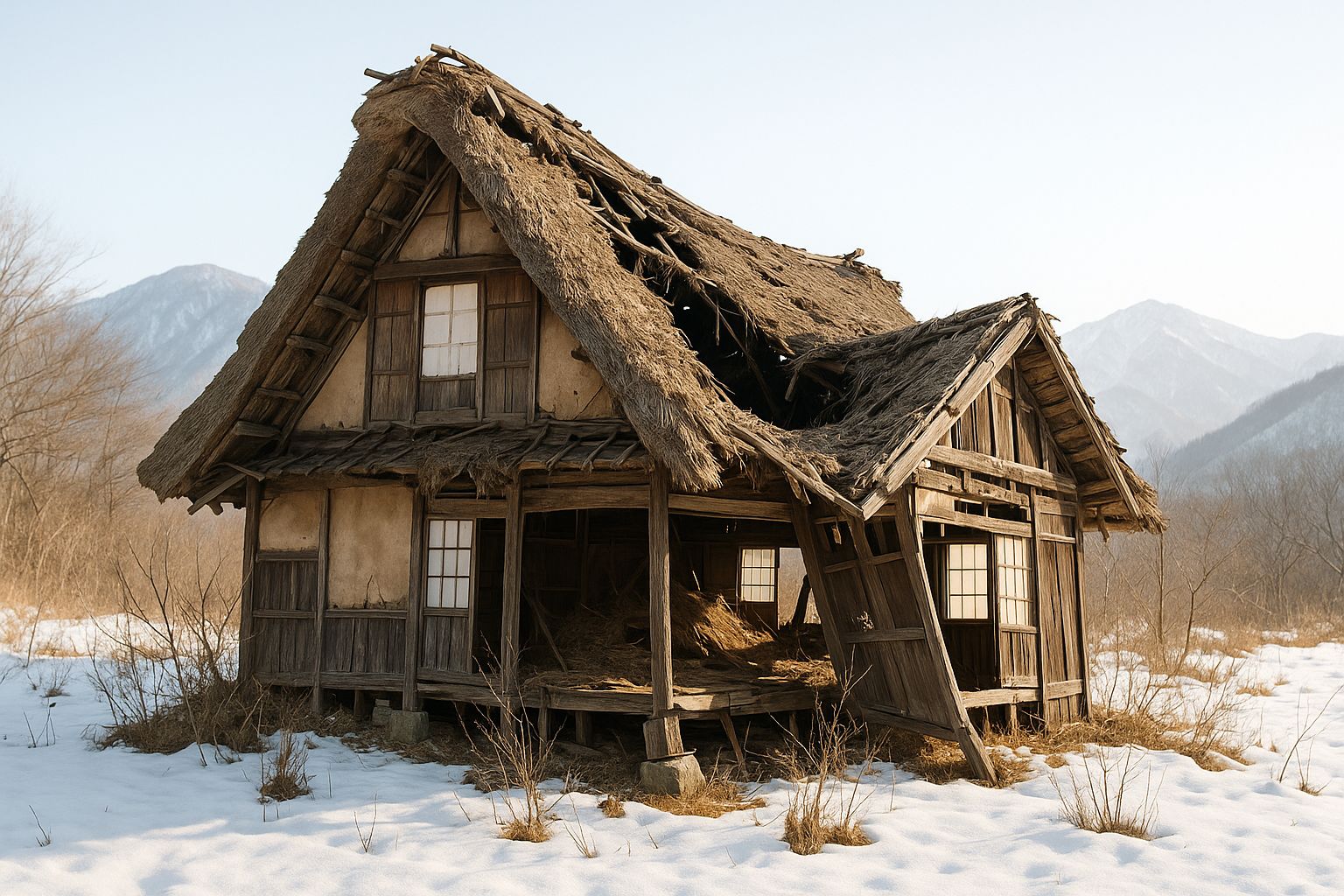
The thatch itself is expected to be finished — it is a wearing surface and thirty years is a life. What must survive is the structure beneath it: the rafters, the tie-beams, and the lashings. If the ridge has broken and folded, the tie-beams have usually gone with it, and at that point we are not restoring a roof, we are building one on top of a souvenir.
Fails on A broken ridge, or rafters carrying more rot than load.
The fire 火
Somebody will light it.
This is not sentiment and it is not negotiable. A minka is preserved by its own smoke; a house restored and then left cold is a house we will be asked to rescue again inside thirty years. We ask who will live here, how often, and whether they understand that an open hearth means smoke in the room. A holiday let opened four weekends a year fails this test, and it is the test most often failed.
Fails on Nobody in residence, or an owner who wants the look without the fire.
Saying no is most of the work.
Thirty-six houses a year get a written answer that Ibushi is the wrong workshop for them. It is not a soft letter. It says what we found, which of the four tests it failed, what it would cost to proceed anyway, and what we think the owner should do instead — which is sometimes a demolition contractor and sometimes another trade entirely.
We do this because the alternative is worse. An owner who is told a frame can be saved when it cannot spends two years and a great deal of money discovering it by other means. And a workshop of eleven people that takes on a house it cannot honestly finish is a workshop that will finish nothing else that year.
There is one more reason, and it is the least comfortable. Every kominka we take is one we can point at afterwards. If we take a house that was never going to carry, the finished building argues against everything on this site.
You write
Where the house is, roughly when it was built if you know, and how long it has been empty. Photographs of the roof from outside and of the largest post you can find inside are worth more than any description.
We answer within the week
Sometimes the answer is already no, from the photographs, and we will not charge for that. Sometimes it is a date.
One day on site
The tōryō and one carpenter. We sound the frame, plug the pillar, go into the roof, and open one section of floor. It is a physical inspection and it leaves small, repairable marks.
A written verdict
Within three weeks: the four tests answered one by one, the frame drawn as we found it, and either a range for the work or the reasons we are declining. Yours to keep and to show to anyone.