Nothing is fastened.
Everything holds.
A minka is a post-and-beam frame carrying a very heavy roof, standing on stones it is not attached to, cut so that no part of it needs a nail. Take the walls away and it stands. Take the roof away and it stands. The walls are infill and the roof is a consumable.
Every choice below has a reason that is structural before it is cultural, and each one is still how we work — because the failure modes the old carpenters were designing against have not changed.
Ishiba-date 石場建て
standing on stones
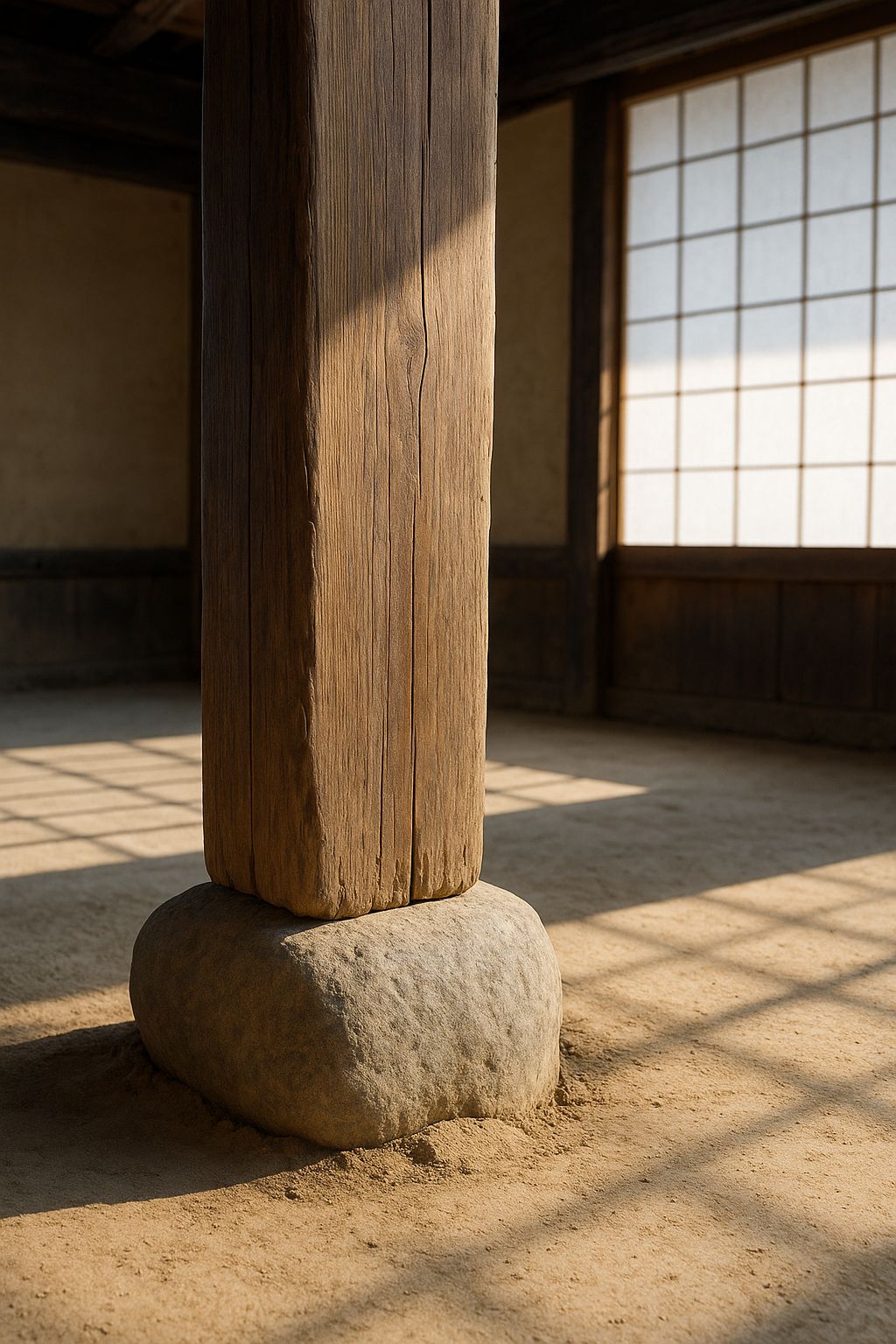
The posts are not fixed to the ground. Each one stands on a foundation stone, and the foot of the post is scribed and cut to fit that particular stone's irregular top face — a technique called hikari-tsuke, where the carpenter transfers the stone's profile onto the timber and cuts to it.
Nothing bolts it down. In an earthquake the building is free to shift, rock, and settle back rather than transmit the ground's movement straight up into the frame. A rigidly anchored house resists until something breaks; this one moves and then stops moving. The mass of the roof, which looks like the danger, is actually what returns it to rest.
- Fixing
- None
- Fitting
- Hikari-tsuke — scribed to the stone
- Behaviour
- The house rides the ground
Kigumi 木組み
timber, joined
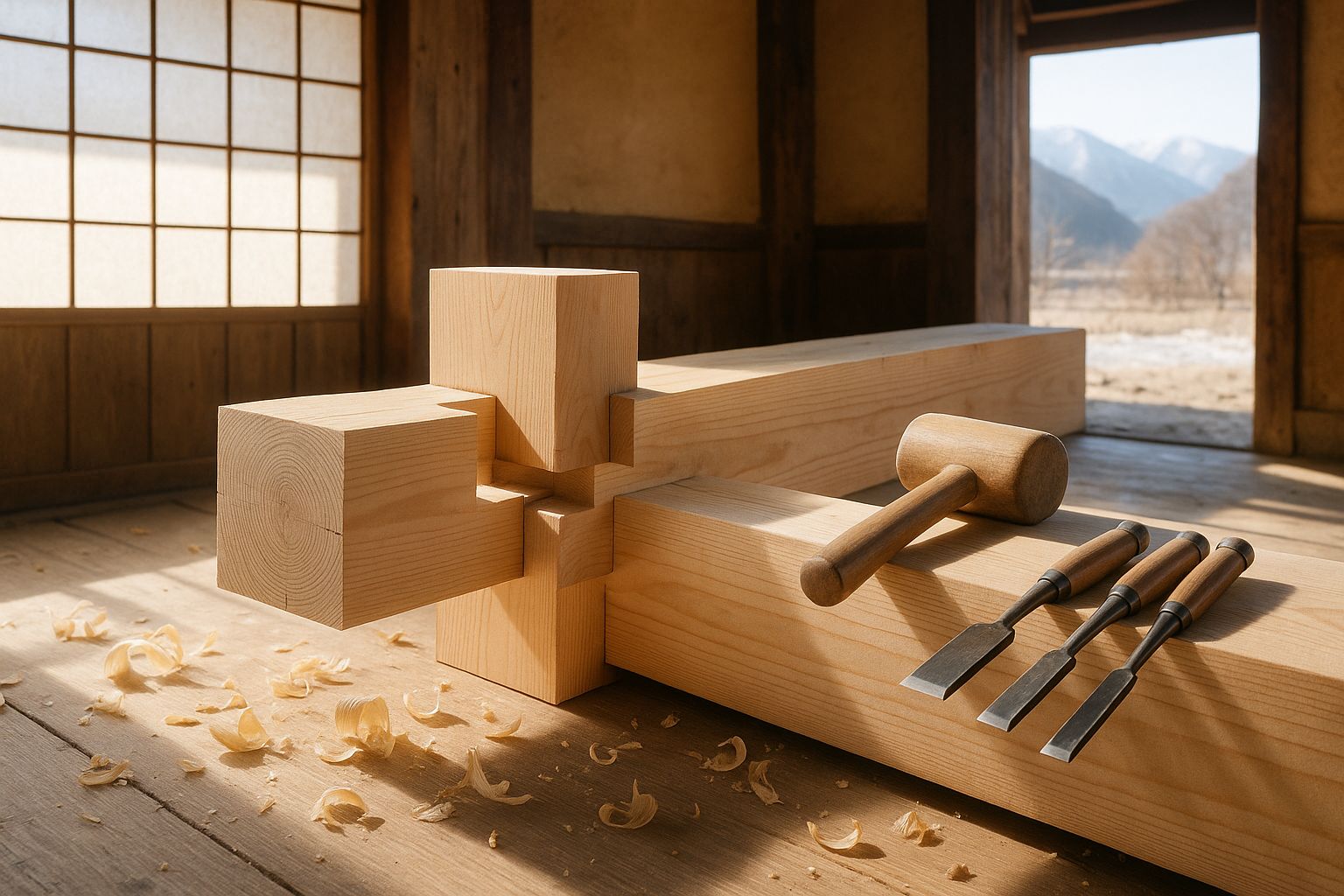
No nails, no plates, no screws. The timbers are cut so that they hold each other — mortise and tenon, lapped scarfs, wedged and pinned with hardwood where a joint needs locking. A hundred and fifty joints in a small nōka, each one cut to a specific pair of timbers and to no others.
The argument is not romantic. A steel fastener in a timber that moves seasonally works its hole loose and then rusts, and the rust breaks down the wood around it. A cut joint has no such failure mode: it is the same material as the thing it joins, it moves with it, and when it does wear it can be shimmed and re-wedged rather than replaced.
- Fasteners
- None — hardwood pins and wedges only
- Marking
- Sumitsuke 墨付け, before any cut
- Repair
- Shimmed and re-wedged, not replaced
Daikokubashira 大黒柱
the great pillar
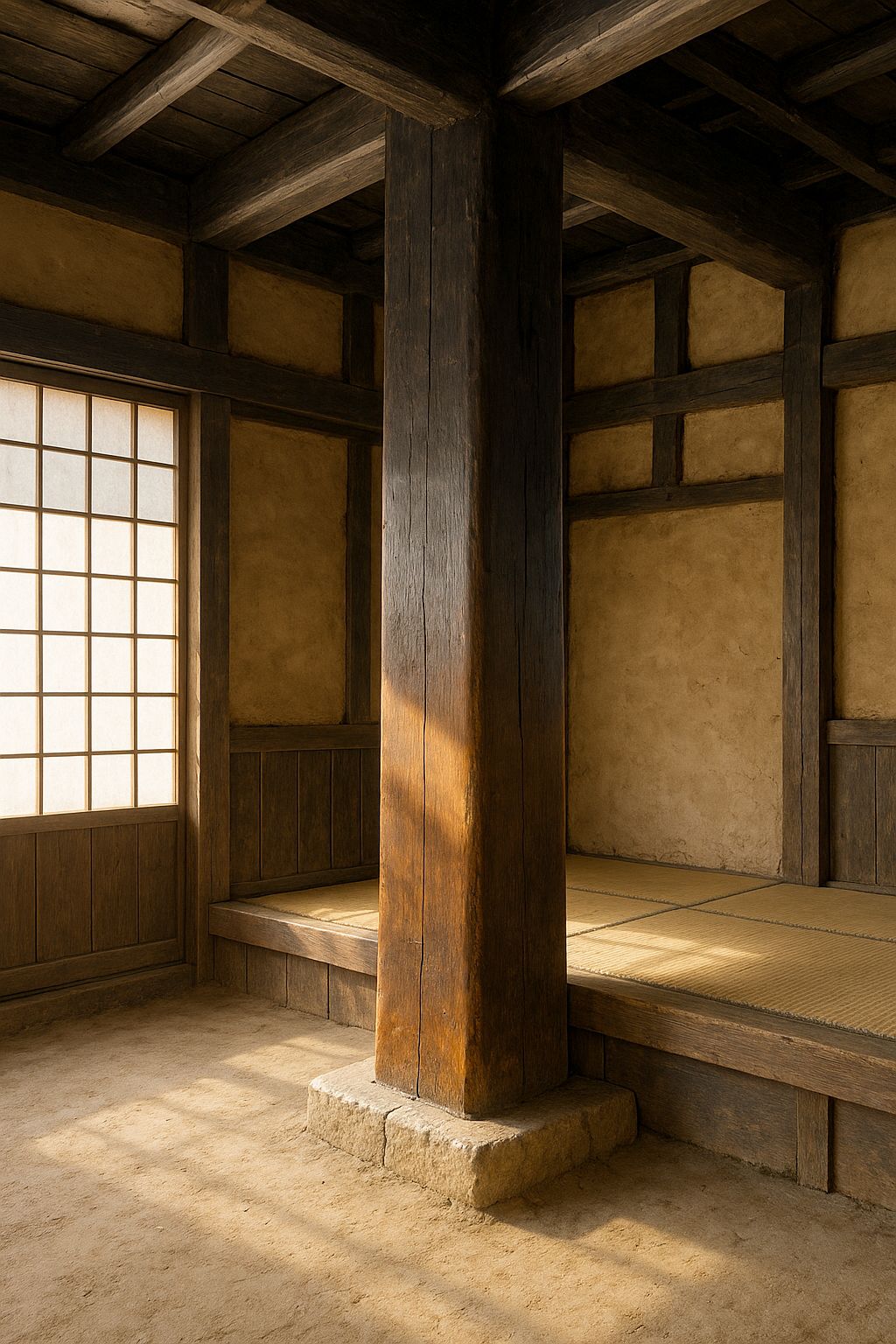
One post, usually zelkova, usually the largest single piece of timber in the building, standing at the junction of the doma and the raised floor where the main beams cross. It is named for Daikoku, one of the seven gods of fortune, and a household's standing could be read off its girth.
Structurally it takes the crossing of the principal beams and carries a large share of the roof. Socially it is the fixed point of the house: the family's height marks were cut into it, and the phrase is still used of a person who holds a household together. In a revival it is the one timber we will go to great lengths not to replace — a house that loses its daikokubashira has, in the view of most of the families we work for, become a different house.
- Species
- Keyaki (zelkova), sometimes chestnut
- Section
- Commonly 1 shaku square or more
- Position
- Where the doma meets the raised floor
Magari-bari 曲がり梁
the curved beam
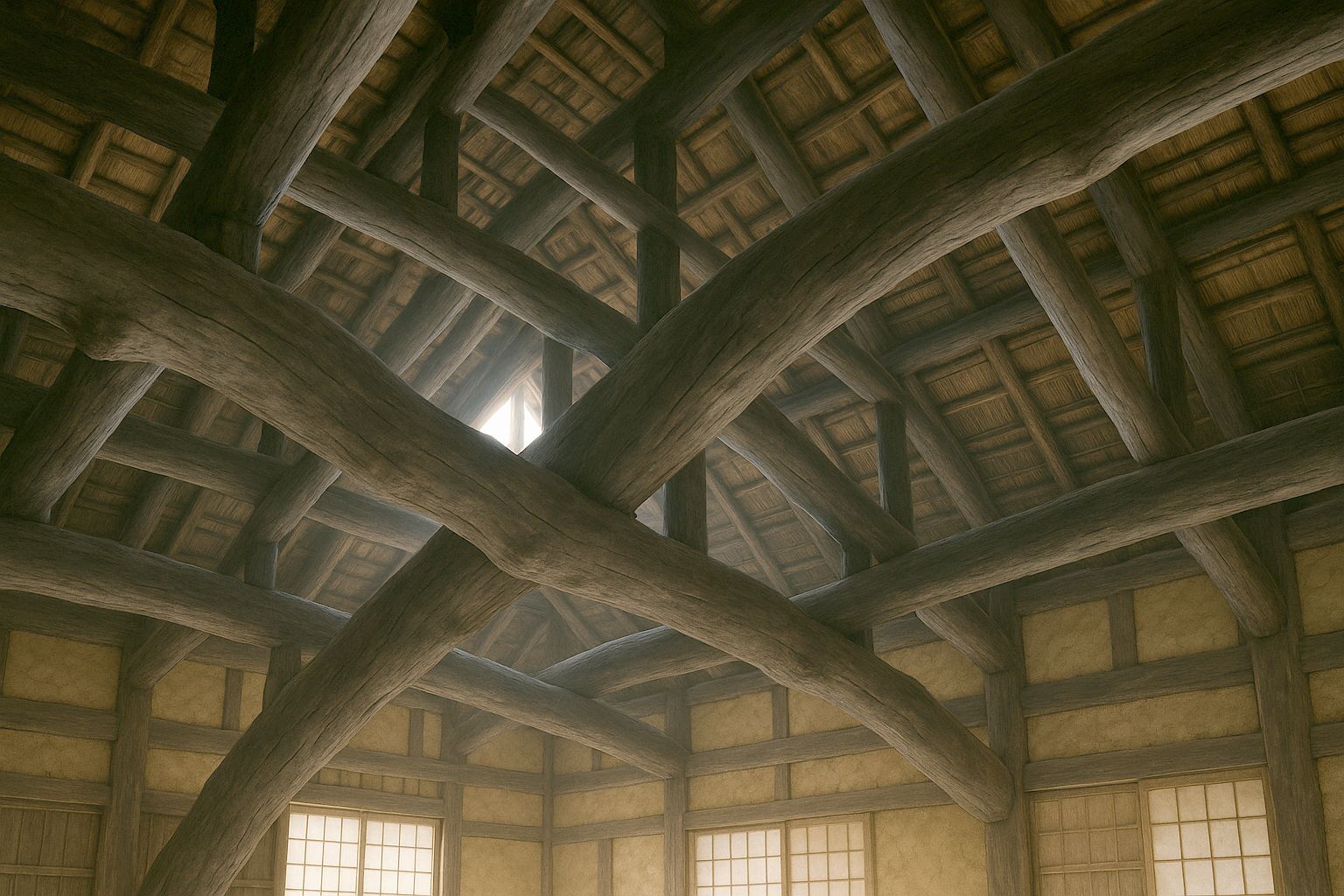
The great tie-beams are not straight and were never meant to be. Mountain pine grown on a slope leans, and the carpenter selects for that lean rather than against it, setting the beam with its natural curve arched upwards so the load pushes into the grain rather than across it.
It also means every beam is unique, which is precisely why the ink line matters. A straight line snapped along a crooked timber gives the carpenter a true datum on an untrue object; every cut is then measured from the line, not from the wood. Straight lines on crooked timber is the whole of Japanese carpentry in one image.
- Species
- Mountain pine (akamatsu)
- Selection
- Chosen for the curve, set arch-up
- Datum
- The snapped ink line, never the timber's face
The frame is finished by being used.
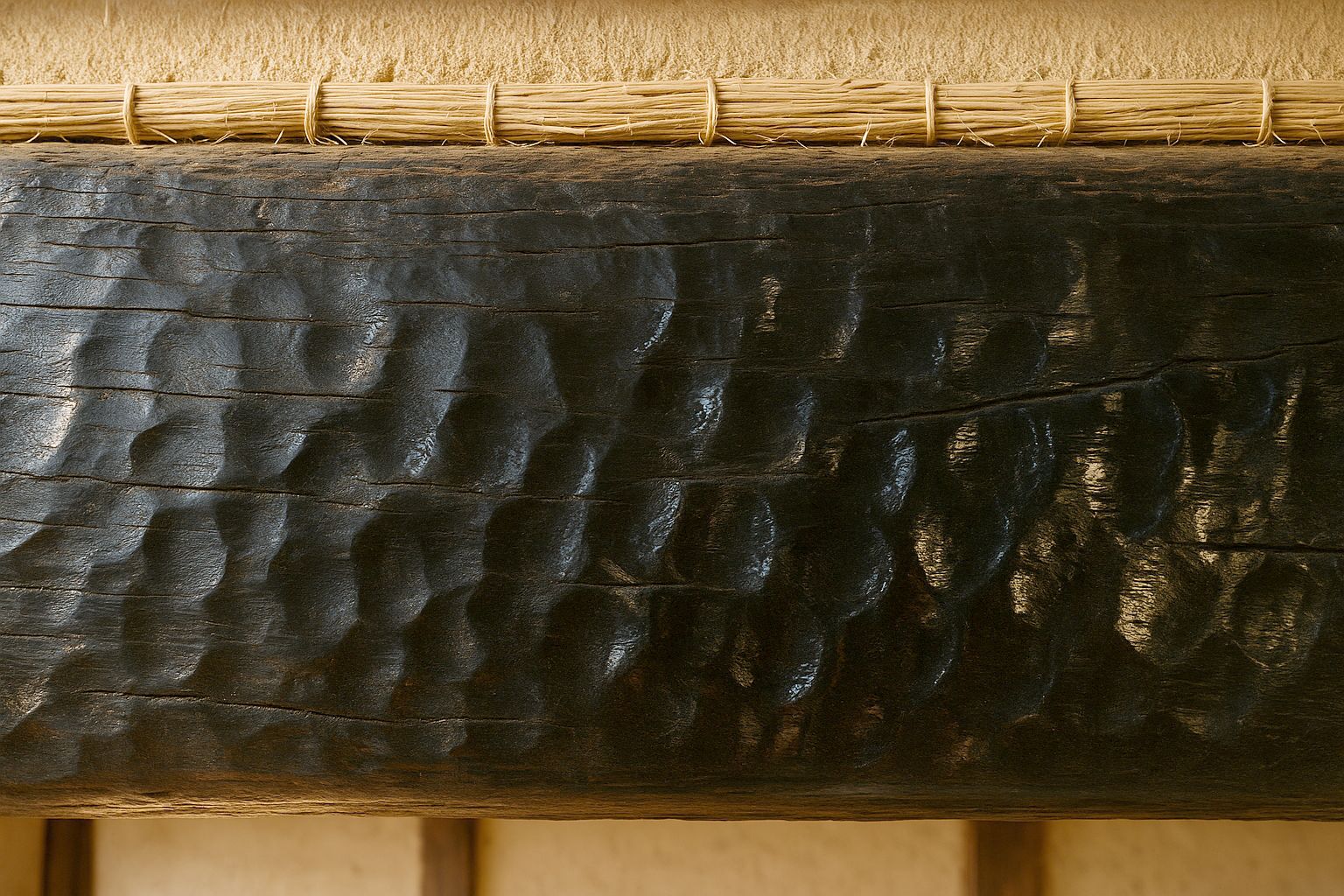
None of the timber above is treated, painted, oiled, or sealed. It is cut, fitted, and then left to the fire. Over decades the hearth smoke lays down a hard carbon lacquer on every exposed surface — insects will not bore it, water will not sit on it, and rot cannot take hold.
The bamboo lattice up in the roof gets the same treatment and becomes susutake 煤竹, which after a century is harder, darker, and worth considerably more than the bamboo that went in. We pull it at re-thatch and sell it by the pole.
It is the reason we ask whether the fire will be lit. A frame like this, kept dry and kept smoked, will outlast several owners. The same frame in an unheated house is on a thirty-year clock.
Susutake, by the pole →See it in section.
The posts, the stones, the tie-beam and the hearth, drawn to scale for a house you set yourself.